Service Areas
Explore how we support product, infrastructure, and automation priorities.
Product Development
Help your product teams move faster and more reliably. We stabilize your applications so you can ship new features without constant firefighting.
Explore this area →
Infrastructure & Operations
Take control of your cloud costs and reliability. We help you build infrastructure that's predictable, secure, and cost-effective as you grow.
Explore this area →
Automation & AI
Free up your team from repetitive work. We help you automate operations and integrate AI safely, so your engineers focus on what matters.
Explore this area →
AI-Powered Business Process Automation: A Guide for Mid-Market Companies in 2026
Mid-market companies struggle to efficiently operate without increasing headcount, manual work and operational cost. In 2026, AI-powered business process automation has evolved fro

Mid-market companies struggle to efficiently operate without increasing headcount, manual work and operational cost. In 2026, AI-powered business process automation has evolved from a competitive advantage into a business necessity, helping organizations navigate growing cost and productivity challenges. Nearly 95% of U.S. industrial businesses plan to introduce new automation within the next three years. Companies are accelerating automation to address labor shortages, improve productivity, and remain competitive. AI-powered business process automation is the use of artificial intelligence to automate repetitive business tasks and workflows. In this guide, let's examine the benefits of AI-powered business process automation, identify the workflows that are best suited for automation, explain the technologies driving today's intelligent systems, and outline a practical roadmap for getting started.

What is AI-Powered Business Process Automation?
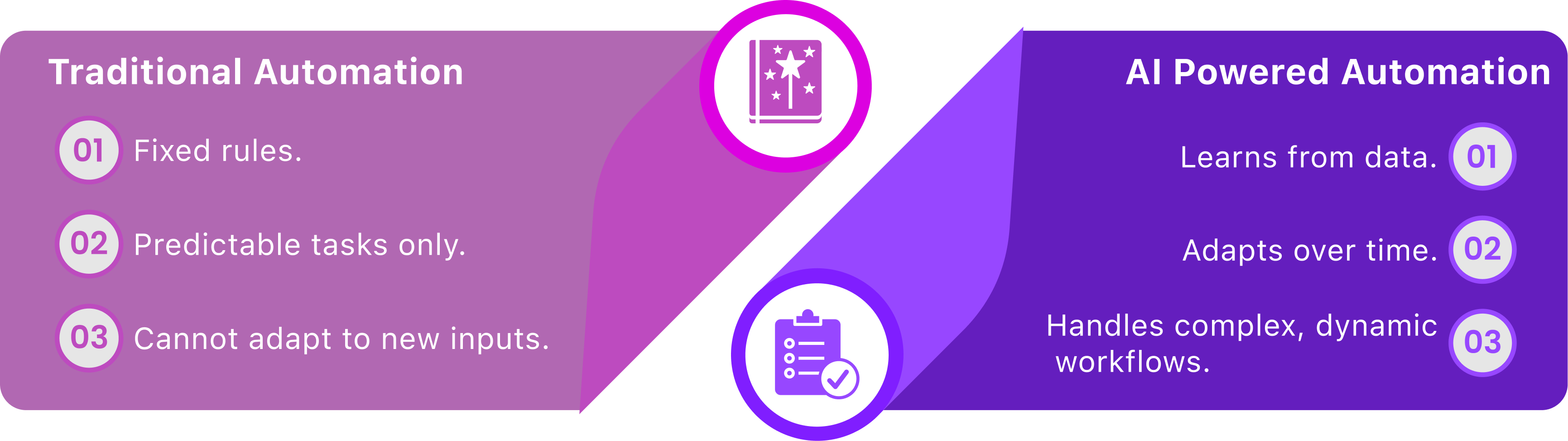
At its core, AI-powered business process automation is about creating smarter workflows because it can analyze information, identify patterns, and adapt to changing conditions. Rather than requiring employees to manually handle repetitive tasks, review large volumes of data, or move information between systems, AI enables processes to operate with greater speed, accuracy, and intelligence. This allows organizations to streamline day-to-day operations while freeing teams to focus on strategic initiatives and customer-facing activities. Unlike traditional automation which is designed to execute tasks based on fixed rules, making it effective for routine and predictable processes, AI-powered automation can interpret data, learn from past outcomes, and make data-driven decisions, enabling organizations to automate more complex workflows and respond dynamically to changing business needs.
Why Mid-Market Companies Need It Now
Mid-market companies are businesses employing 100 to 2,000 employees, generating about $10M to $1B in revenue. They often find themselves in an operational middle ground, since manual processes such as disconnected systems, email-based approvals, and administrative tasks become increasingly difficult to manage as they grow. While most mid-market companies have IT support in place, having the right expertise to strategically adopt AI and automation is an entirely different challenge.
For many mid-market companies, the true cost extends far beyond employee salaries. Even if the manual costs seem manageable on the surface, repetitive tasks consume valuable time that could be spent on higher value work. Manual workflows also increase the likelihood of human error which can result in rework, compliance risks, customer dissatisfaction, and missed revenue opportunities.
Meanwhile, larger enterprises have been investing in AI-powered automation for years, which is enabling them to streamline operations, reduce costs, and deliver faster customer experiences at scale. As these capabilities become more advanced and accessible in 2026, mid-market companies that heavily rely on manual processes continue to fall behind. Slower workflows, higher operational costs, and limited scalability can make it increasingly difficult to meet customer expectations and respond to market changes. As a result, the gap between automated and non-automated organizations is widening, turning automation from a competitive advantage into a business necessity.
What Business Processes Should You Automate First?
Not every business process is an ideal candidate for automation. However, there are certain processes that, if automated, can significantly maximize return on investment. Mid-market companies should focus on workflows that are repetitive, time-consuming, prone to human error and involve high volumes of data or transactions. A good rule of thumb is to identify processes that consume significant employee time but add little strategic value.
1. HR and Onboarding
Human resources teams often spend significant time on repetitive administrative tasks such as processing hiring paperwork, onboarding new employees, managing leave requests, and coordinating performance reviews. When handled manually, these processes lead to delays, data entry errors, compliance risks, and a frustrating experience for both HR staff and new hires. AI-powered automation streamlines these workflows by automatically generating documents, digitizing onboarding forms, routing approvals, and maintaining employee records across systems, enabling HR teams to reduce workloads, improve accuracy, and create a seamless employee experience from day one.
2. Finance and Invoicing
Finance teams spend significant time on high-volume tasks like invoice processing, purchase order approvals, bank reconciliation, and payment processing. When handled manually, these workflows create data entry errors, delayed cash flow, compliance risks, and limited financial visibility. AI-powered automation accelerates invoice processing, generates reports automatically, and reconciles transactions without manual effort.
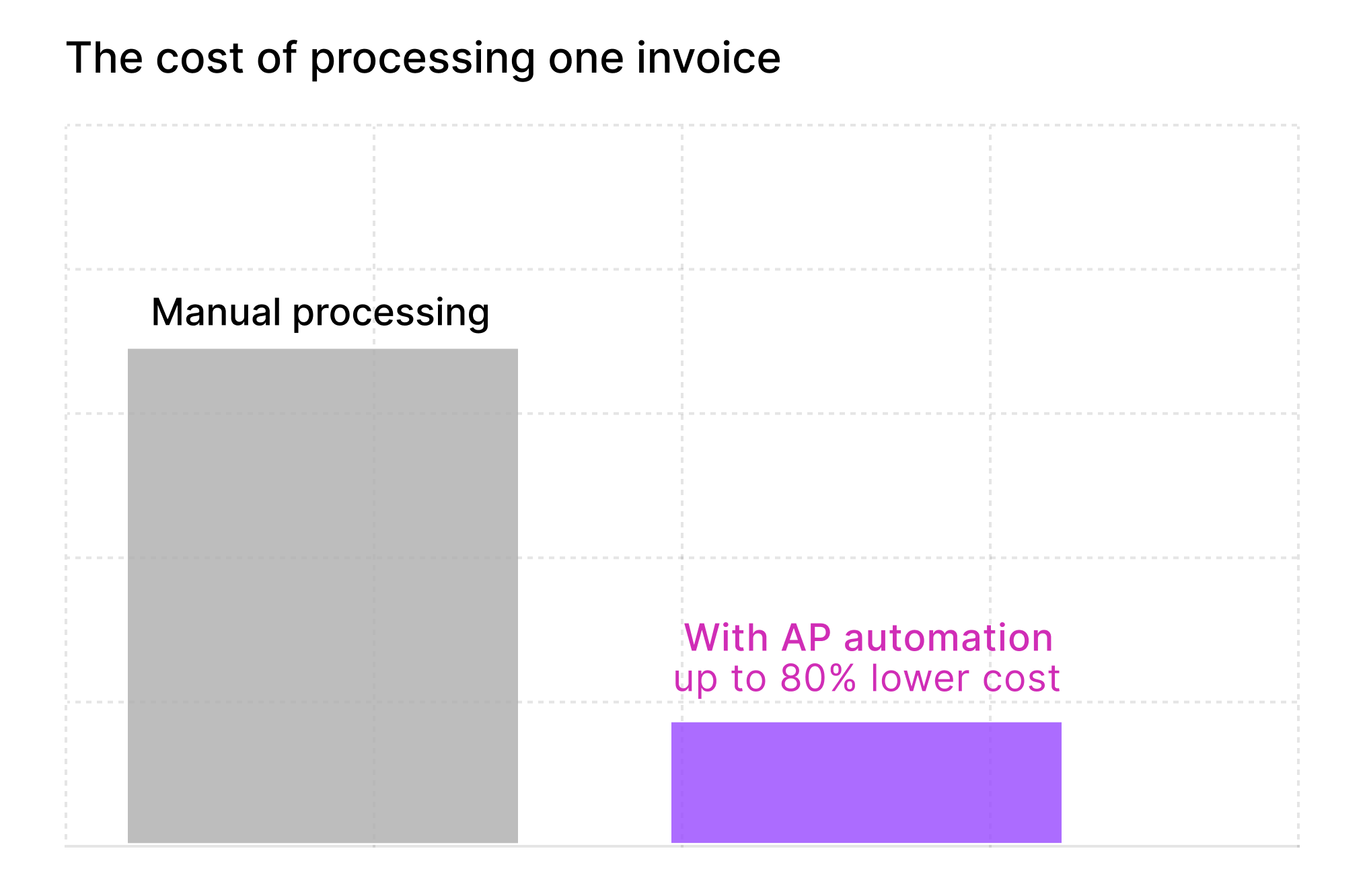
AP automation can reduce invoice processing costs by up to 80%, allowing finance teams to shift focus from data entry to strategic financial planning.
3. IT Operations
IT teams are often responsible for repetitive tasks such as managing help desk tickets, monitoring systems, performing software updates, resetting passwords, and tracking network performance. When these activities are handled manually, organizations may experience slower response times, increased system downtime, and overburdened IT staff who spend more time resolving routine issues than driving innovation. AI-powered automation helps by automatically routing and resolving support tickets, proactively monitoring systems for potential issues, providing self-service support options, and automating software patching and updates. IT automation can resolve up to 40% to 60% of support tickets without human intervention.
4. Customer Support
Customer support teams spend a significant amount of time responding to customer inquiries, tracking orders, routing support requests, and resolving complaints across multiple channels. When these processes are managed manually, businesses often struggle with slow response times, inconsistent service quality, and rising support costs as customer volumes increase. AI-powered automation addresses these challenges through intelligent chatbots, automated request routing, and sentiment analysis tools that help prioritize and resolve issues more efficiently. This enables organizations to deliver faster, more consistent customer experiences while reducing operational cost. AI can handle up to 80% of routine customer inquiries.

5. Compliance & Reporting
Compliance and reporting teams often spend considerable time maintaining audit trails, preparing regulatory reports, enforcing internal policies, and managing large volumes of documentation. When these activities are performed manually, organizations face an increased risk of human error, missed deadlines, compliance violations, and potentially costly penalties. AI-powered automation helps address these challenges by automatically tracking activities, monitoring compliance requirements in real time, generating reports, and maintaining accurate, audit-ready records. As a result, businesses can strengthen regulatory compliance, reduce administrative workloads, and improve audit readiness.
How AI Makes Automation Smarter
AI-powered automation is not just about replacing manual tasks, it is about making processes smarter, faster and more adaptive over time. This intelligence is made possible by a set of core technologies that allow systems to learn from data, predict outcomes, and understand human communication. The following technologies are what make modern automation truly intelligent.
1. Machine Learning
Machine learning is a type of AI that enables systems to learn from data and improve their accuracy over time without being explicitly programmed. In automation, it works by analyzing historical business data and continuously refining its decisions as new patterns and outcomes are observed. For example, a mid-market company can use it to process invoices more accurately over time by learning which entries are likely errors or duplicates based on past cases. This results in smarter automation that reduces manual review, improves accuracy, and becomes more efficient as the business scales.
2. Predictive Analytics
Predictive analytics is a branch of AI that uses historical data to forecast future events or outcomes before they happen. In automation, it works by analyzing patterns in past business behavior and using them to predict risks, demand, or failures in advance. For example, a mid-market company can use predictive analytics to identify when a machine is likely to break down or when a customer is at risk of leaving, allowing early action. This helps businesses prevent problems instead of reacting to them, reducing downtime, improving customer retention, and lowering operational costs.
3. Natural Language Processing
Natural Language Processing (NLP) is a branch of AI that enables systems to understand, interpret, and respond to human language in a meaningful way. In automation, it works by analyzing text or speech inputs such as emails, chat messages, and support requests, and converting them into structured data that systems can act on. For example, a mid-market company can use NLP-powered chatbots to instantly respond to customer queries or automatically analyze customer feedback to detect complaints and sentiment. This leads to faster communication, lower customer support costs, and 24/7 service availability without increasing human workload.

How to Get Started
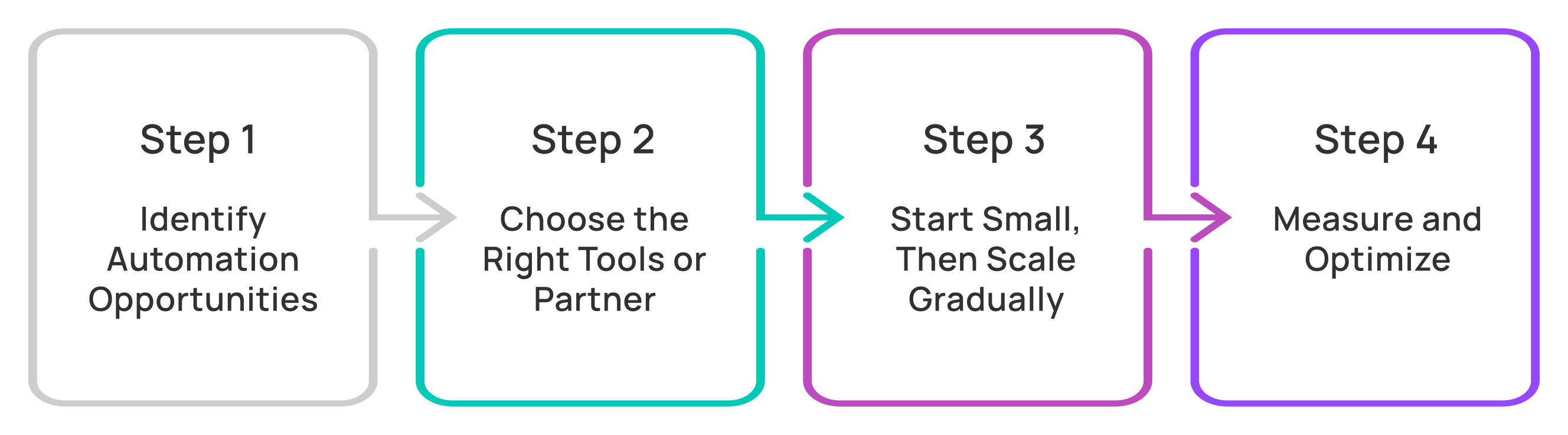
Getting started with AI-powered automation doesn't have to be overwhelming. The key is to take a structured, step-by-step approach that focuses on high-impact areas first rather than trying to automate everything at once. By starting small and scaling gradually, mid-market companies can reduce risk, control costs, and build confidence in their automation strategy.
Step 1: Identify Automation Opportunities
Begin by analyzing existing workflows to find tasks that are repetitive, time-consuming, and rule-based. Focus on processes that involve high volumes of manual work, such as data entry, approvals, customer queries, or reporting. These are usually the best candidates for quick automation wins.
Step 2: Choose the Right Tools or Partner
Once opportunities are identified, select automation tools or an implementation partner that fits business needs and technical capacity. Look for solutions that integrate easily with existing systems, are scalable, and support AI capabilities such as machine learning, NLP, or predictive analytics.
Step 3: Start Small, Then Scale Gradually
Instead of transforming everything at once, begin with one or two pilot projects in a specific department. This allows organizations to test performance, fix issues, and demonstrate value before expanding automation across the organization.
Step 4: Measure and Optimize
Track key performance metrics such as time saved, error reduction, cost savings, and process efficiency. Use these insights to continuously refine automation strategy and expand into additional workflows where ROI is highest.
Conclusion
AI-powered business process automation is no longer a future concept, it is a practical necessity for mid-market companies looking to improve efficiency, reduce operational costs, and stay competitive in an increasingly digital economy. By leveraging AI-driven tools, organizations can streamline workflows, eliminate repetitive manual work, and make faster, more intelligent business decisions.
ConvergeStack helps businesses design and implement scalable AI automation solutions tailored to their operational needs and growth goals. From strategy to execution, the focus is on delivering measurable business impact through intelligent automation.
For mid-market companies ready to transform their operations and unlock the full potential of AI, the next step starts here: ConvergeStack