Service Areas
Explore how we support product, infrastructure, and automation priorities.
Product Development
Help your product teams move faster and more reliably. We stabilize your applications so you can ship new features without constant firefighting.
Explore this area →
Infrastructure & Operations
Take control of your cloud costs and reliability. We help you build infrastructure that's predictable, secure, and cost-effective as you grow.
Explore this area →
Automation & AI
Free up your team from repetitive work. We help you automate operations and integrate AI safely, so your engineers focus on what matters.
Explore this area →
Managed IT Services for Mid-Market Companies: What to look for in 2026
Mid-market companies across the US are stuck in a dangerous middle ground, their operations are too complex for basic IT yet not big enough for a full enterprise IT department, exa

Mid-market companies across the US are stuck in a dangerous middle ground, their operations are too complex for basic IT yet not big enough for a full enterprise IT department, exactly where managed IT services are needed the most. Mid-market companies are businesses employing 100-2000 employees, generating about $10M to $1B revenue. They are held back by serious problems like unpredictable IT costs, rising cyber threats and scaling challenges. In fact 43% of cyberattacks target small and mid-sized businesses, an inevitable risk. In this guide, we break down what to look for in a managed services provider in 2026, how much it costs, and what red flags to avoid.

What are Managed IT Services?
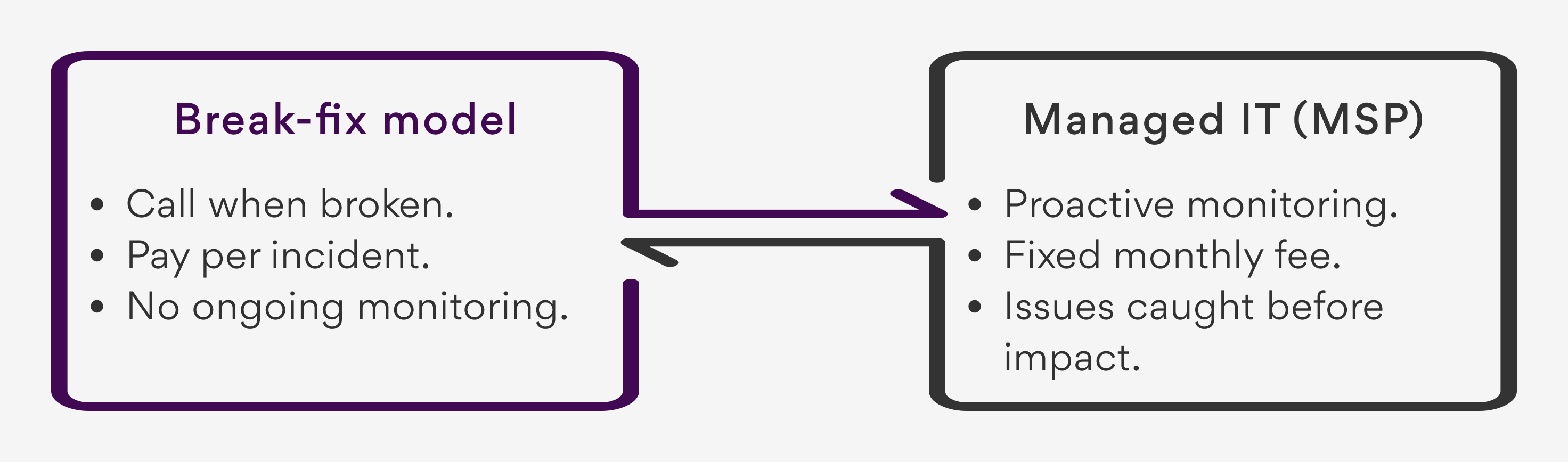
Managed IT Services are the services that businesses outsource to external IT providers called MSP (Managed Service Providers), essentially acting as an extension of their internal team. Unlike the traditional break-fix model where businesses only call for help after something goes wrong, managed IT services take a proactive approach, identifying and preventing problems before they disrupt operations. Rather than paying per incident, businesses pay a consistent monthly fee for ongoing support, monitoring and maintenance. On a regular basis, MSPs are proactively involved in issue detection, user support, cloud services, network management, cybersecurity monitoring and software updates. On the security front, MSPs provide continuous threat monitoring, endpoint protection, and patch management and ensure their systems are defended around the clock. Mid-market companies gain access to a full team of senior IT engineers, security specialists, and cloud architects , expertise that would cost $300K+ per year to hire internally.
Why Mid-market companies need Managed IT Services now?
Mid-market is one of the most rapidly growing business markets. The growth and development of mid market companies create a need for reliable, secure IT infrastructure. However, they are caught in the gap between basic IT support and enterprise level IT, since they cannot use basic IT support nor build a full expert IT department due to its cost. Here is why managed IT services are no longer optional for mid-market companies:
What to look for in a Managed Service Provider in 2026
Choosing the best managed service provider is as important as deciding to include managed IT services in your team. Here is what you need to look for in your MSP in 2026 to get the most out of your business:
3.1 Cybersecurity-First Approach
Cybersecurity-first means building their IT around protection from the start, not as an afterthought. That includes tools like EDR for threat detection, SOC for 24/7 monitoring, and MFA for secure access. In 2026, this is critical for mid-market companies because they’re heavily targeted but often under-protected. When choosing an MSP, ask what security tools they include, how they monitor threats, and how quickly they respond.
3.2 Response Time and SLA Transparency
An SLA (Service Level Agreement) is a clear promise from their IT provider about how fast and reliably they’ll respond when something goes wrong. For a mid-market company, guaranteed response times matter because even a short outage can stop operations, cost money, and hurt customer trust. Without an SLA, they're left guessing when support will arrive. Companies should look for defined response and resolution times, 24/7 support availability, and penalties if those promises aren’t met. They should also ask how incidents are prioritized and how performance is tracked and reported.
3.3 Growth-Ready IT Support
Growth-ready IT support means the MSP can expand alongside a business without slowing it down. As companies grow by adding employees, opening new offices, or moving further into the cloud, their IT support should adjust smoothly without constant rework or delays. For mid-market companies, this is crucial because growth often happens quickly and unpredictably. When evaluating an MSP, ask how they handle onboarding new users, supporting multiple locations, and expanding cloud infrastructure. They should also look for flexible pricing and a clear plan for supporting future growth.
3.4 AI & Automation Capabilities
AI in managed IT in 2026 is used to continuously monitor systems, detect unusual behavior, and predict issues before they cause downtime or security breaches. Automation handles repetitive tasks like software updates, patching, backups, and routine maintenance without manual effort. For mid-market companies, this matters because it leads to faster response times, fewer human errors, and lower operating costs while maintaining enterprise-level performance and security. When evaluating an MSP, ask what AI tools they use, how their automation handles after-hours incidents, and whether their systems offer predictive alerts before issues escalate.
3.5 Industry & Compliance Experience
Different industries have different compliance requirements, and an MSP should understand the specific regulations that apply to their business. For mid-market companies, common frameworks include HIPAA (healthcare), SOC 2 (data security), CMMC (government contractors), and PCI-DSS (payment data). This matters because failing to meet these standards can lead to heavy fines, legal issues, and loss of customer trust. A capable MSP should help them stay compliant, not just secure. Ask what compliance experience they have, which frameworks they support, and how they handle audits, reporting, and data protection.
3.6 Co-Managed IT Option
Co-managed IT is a partnership model where an internal IT team works alongside an MSP instead of being replaced. It is best suited for companies that already have in-house IT staff but need additional support, expertise, or extended coverage. In this setup, the MSP typically handles routine tasks, monitoring, and specialized functions, while the internal team focuses on strategic and business-specific priorities. This approach is often ideal for mid-market companies because it fills capability gaps, reduces workload, and provides access to 24/7 support without the cost of expanding the internal team. When evaluating an MSP, companies should ask how responsibilities are divided, how communication is managed, and how the provider integrates with and supports the existing team.
How Much Do Managed IT Services Cost?
The cost of managed IT services is not one-size-fits-all. Pricing varies significantly depending on the size and complexity of a company's IT environment, the level of cybersecurity protection required, the nature of existing infrastructure, and the volume and sophistication of threats the business faces. Companies operating in regulated industries such as healthcare, finance, or government contracting may also face higher costs due to the additional monitoring, reporting, and compliance governance required to meet standards like HIPAA, SOC 2, or CMMC.
To understand the value, it helps to compare the alternatives. Building an in-house IT team means hiring multiple specialists, from helpdesk technicians to security engineers and cloud architects, with average salaries ranging from $61K to $84K per year per employee, not including benefits, training, and equipment costs. The traditional break-fix model, while seemingly low-cost upfront, results in unpredictable expenses that spike during outages or security incidents, typically charging between $125 and $200 per hour with no guarantee of resolution time. Managed IT services bring all of these needs together under a single predictable monthly engagement, giving mid-market companies access to an entire team of specialists without the overhead and complexity of building one internally.
Red Flags to Watch Out for
Not all MSPs operate at the same level, and certain warning signs can indicate weak service quality or poor long-term fit. Watch out for these red flags when evaluating an MSP:
Questions to Ask Before Signing
Before signing an MSP contract, it is important to clarify expectations around service, security, and long-term flexibility to avoid misunderstandings later.
To make the evaluation process easier, here are some of the most important questions to ask along with what a reliable MSP should be able to answer:
Q: What is included in the monthly fee? → A reliable MSP should clearly outline all services covered under the monthly fee, including help desk support, monitoring, security, and maintenance. Any additional services billed separately should be disclosed upfront
Q: How are after-hours incidents handled? → The MSP should have a defined process for handling critical incidents outside of business hours, including escalation procedures and guaranteed response times around the clock.
Q: What does the onboarding process look like? → Structured onboarding process typically includes a full audit of existing systems, a transition plan, and a defined timeline. Most onboarding periods range from 30 to 90 days depending on complexity.
Q: What happens if we want to exit the contract? → The MSP should have a clear off-boarding process that includes full data handover, documentation of all systems, and no penalties for leaving after the agreed contract term.
Asking these questions upfront not only helps identify the right MSP but also sets the foundation for a transparent, accountable, and long-term partnership.
Conclusion: Managed IT Services for Mid-Market Business
Choosing the right MSP goes beyond comparing prices. For mid-market companies, the real value lies in finding a partner that understands their security needs, grows with their business, responds when it matters most, and aligns with their long-term goals. Companies that take the time to evaluate these factors are not just making an IT decision, they are making a business decision that directly impacts their risk, efficiency, and ability to stay competitive in a market that never slows down. This is where a cybersecurity-first, scalable, and compliance-aware approach becomes essential. ConvergeStack is built around helping mid-market organizations strengthen their IT foundation while supporting growth without complexity or disruption. The next step is to evaluate current IT gaps and compare them against what a modern MSP should deliver. Schedule a free IT strategy call with ConvergeStack's senior engineers at ConvergeStack